Sildenafil, Beta-Blockers, and Benzodiazepines in Freediving: An Evidence-Based Review
Three drug classes come up repeatedly in freediving forums and locker-room conversation: PDE5 inhibitors (sildenafil/Viagra, tadalafil/Cialis), beta-blockers, and benzodiazepines. All three sit in an unusual regulatory position — none is on the World Anti-Doping Agency's universal Prohibited List for endurance sport in general, yet all three have ended competitive careers in freediving specifically. This article works through the pharmacology of each, summarizes the actual regulatory landscape across federations, walks through a documented 2023–2024 case that illustrates how the rules are enforced in practice, and evaluates what the exercise-physiology literature does and does not support about performance effects. The goal is to replace speculation with mechanism and citation.
Where these drugs sit on the enhancement spectrum
It is useful to separate three categories that get conflated in casual conversation. Dietary supplements are freely available, non-synthetic, and generally legal everywhere; their efficacy varies widely, but a few are unusually well supported. Creatine monohydrate is the standard example: a meta-analytic review in the Journal of the International Society of Sports Nutrition found it reliably improves measures of strength and power output, it occurs naturally in food (though at doses requiring impractical quantities of meat to match a standard 5 g supplemental dose), and it is not prohibited by WADA (Kreider et al., 2017). Sports pharmacology refers to synthetic compounds that are not on the WADA Prohibited List but are used off-label for a training or competitive edge. Doping, in the strict sense, means using compounds that are explicitly banned for the sport in question. Sildenafil and benzodiazepines fall into the second category under WADA's global rules — but, as the next section explains, a federation is free to add its own restrictions on top of the WADA baseline, and CMAS has done exactly that for freediving.
The regulatory paradox: one molecule, two rulebooks
AIDA International defers to the standard WADA Prohibited List without sport-specific additions. CMAS, by contrast, maintains its own supplementary anti-doping provisions for freediving that go beyond the WADA baseline, adding phosphodiesterase type 5 (PDE5) inhibitors and benzodiazepines to what its athletes may possess or use in and out of competition. The practical result is a genuine paradox: an athlete can take sildenafil or a benzodiazepine, compete at an AIDA event, and be fully compliant, while the same substance in the same athlete's system (or luggage) at a CMAS event constitutes an anti-doping rule violation. This is not a hypothetical — it has already been tested in competition.
Case study: Vertical Blue, 2023
At Vertical Blue 2023 in the Bahamas, a luggage inspection on 4 July 2023 found sildenafil and benzodiazepines in the possession of two Croatian athletes, Petar Klovar and Vitomir Maričić. Both athletes acknowledged possessing some of the substances, stating they had been recommended by their medical team, and provided prescription documentation for some but not all of what was found (DeeperBlue, 2023). CMAS's disciplinary committee subsequently ruled on the case: both athletes were found guilty of possession of prohibited substances, fined €5,000 each, and given a six-month competition suspension, running from 27 November 2023 to late May 2024, with the ruling announced on 27 January 2024 (Divernet, 2024). Two details are worth underlining for any competitive athlete. First, the violation was possession, not a confirmed positive test — CMAS's rules for freediving extend to what an athlete carries, not only what shows up in a sample. Second, sildenafil is not on the universal WADA list; the violation existed only because of CMAS's sport-specific supplementary provisions. This is the regulatory paradox described above, made concrete.
Beta-blockers: what they do, and why some sports restrict them
Beta-blockers are a mainstay of cardiology, prescribed for hypertension, ischemic heart disease, tachyarrhythmias, and heart failure (StatPearls: Beta-Blockers). Pharmacodynamically, β1-receptor antagonism reduces heart rate and myocardial oxygen demand and dampens the physical tremor associated with sympathetic tone. Under WADA's rules, beta-blockers are prohibited only in disciplines where a lowered heart rate and reduced tremor confer a direct competitive edge — precision sports such as shooting, archery, darts, and billiards, plus a handful of others including some freediving federations' own rulesets (WADA P1: Beta-Blockers). Outside those restricted disciplines, taking a beta-blocker specifically to chase a training effect would fall into the sports-pharmacology category described above rather than doping. Detection is not a significant obstacle for anyone tempted to use them illicitly: elimination half-lives vary by molecule but typically run under a day, while urinary metabolites remain detectable for several days after the drug has cleared systemic circulation, so a doping-control sample taken well after use can still return a positive result.
There is no controlled trial evidence that beta-blockade improves breath-hold duration or dynamic-apnea distance specifically — the physiological rationale athletes cite (a lower resting heart rate meaning "more oxygen in reserve") does not map cleanly onto the diving response, which already produces profound bradycardia on its own through vagal activation, with heart rates of 40–60 bpm typical in trained freedivers and rates as low as 20–24 bpm documented in elite cases (Reider & Stöggl, 2024). Layering pharmacological beta-blockade on top of a reflex that already achieves comparable heart-rate suppression is not an evidence-supported strategy, and it carries its own risk profile (excessive bradycardia, hypotension) in an activity where consciousness and motor control are already being pushed to their limits.
PDE5 inhibitors: mechanism, and the honest state of the evidence
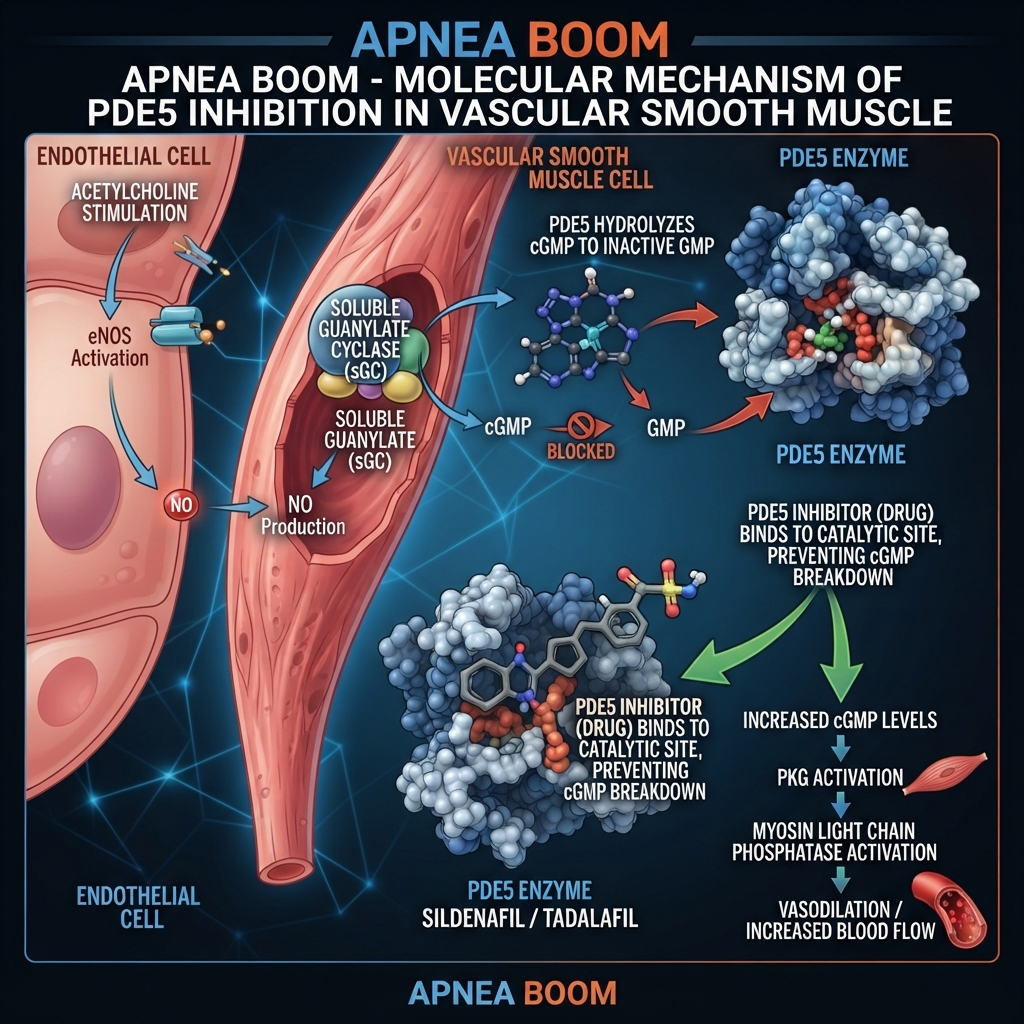
Sildenafil and tadalafil belong to the phosphodiesterase type 5 (PDE5) inhibitor class (StatPearls: Sildenafil; StatPearls: PDE5 Inhibitors). Their mechanism is commonly misdescribed as "raising nitric oxide (NO)." That is not what they do. Nitric oxide, released in response to a physiological stimulus, activates the production of cyclic guanosine monophosphate (cGMP), a second messenger that relaxes smooth muscle and dilates blood vessels. PDE5 is the enzyme that normally breaks cGMP back down; a PDE5 inhibitor blocks that breakdown, so existing cGMP persists and its vasodilatory effect is prolonged and amplified. The drug does not initiate the NO/cGMP cascade — it depends on an existing physiological trigger and simply extends the downstream effect. PDE5 is most densely expressed in penile vasculature, which is the basis for the approved indication, but it is also expressed in the pulmonary vasculature, which is the basis for its approved use in pulmonary arterial hypertension and for most of the speculation about a freediving application.
Here the evidence is genuinely more nuanced than a flat "it does nothing" verdict would suggest, and it is worth presenting that nuance rather than flattening it. A controlled study of ten trained cyclists at a simulated altitude of 3,874 m found that sildenafil reduced six-kilometer time-trial time by an average of 15% relative to placebo at altitude — but the effect was driven almost entirely by four "responder" subjects who improved by 39% on average (up to 45% in one case), while the remaining six "non-responders" improved by only about 1%. Responders were distinguished by a more exaggerated hypoxic pulmonary vasoconstriction response at altitude; sildenafil provided no measurable benefit to either group at sea level (Ricart et al., summarized 2006). That is a real, replicated ergogenic effect — but it is specific to sustained aerobic exercise under hypobaric hypoxia in individuals with an unusually strong hypoxic pulmonary pressor response, and the underlying problem it corrects (excessive pulmonary vasoconstriction impairing gas exchange during prolonged effort) is mechanistically distinct from what happens during a breath-hold. The mammalian diving response is a centrally mediated peripheral vasoconstriction that redirects blood toward the heart, lungs, and brain while shifting plasma into the thoracic cavity to protect the lungs from compression (Apnetica, on the dive reflex). A drug that produces mild systemic and pulmonary vasodilation is, if anything, working against part of that protective reflex rather than replicating the altitude-cycling mechanism. No dedicated controlled trial in breath-hold divers evaluating sildenafil's or tadalafil's effect on static or dynamic apnea performance has been published; extrapolating from the altitude-cycling literature to freediving is speculative in both directions, and the honest position is that the question remains genuinely open rather than settled in either direction.
What is well established is the side-effect profile: headache, flushing, nasal congestion, and a drop in blood pressure are common with PDE5 inhibitors, and hypotension in particular is not a trivial risk to introduce into an activity that already produces significant cardiovascular strain and depends on stable perfusion pressure to the brain.
Benzodiazepines: anxiolysis with a real cost
Benzodiazepines (diazepam, alprazolam, and related compounds) act as positive allosteric modulators of the GABA-A receptor, increasing the frequency of chloride-channel opening in response to GABA and producing anxiolytic, sedative, and muscle-relaxant effects (StatPearls: Benzodiazepines). The theoretical appeal to a freediver is obvious: apnea performance has a substantial psychological component, and anything that blunts panic or the subjective urge to breathe looks, on paper, like it could extend a dive. No controlled study has demonstrated this effect in breath-hold divers, and there is a specific, well-documented reason to be cautious rather than curious about testing it yourself: benzodiazepines are respiratory depressants at the doses used for meaningful sedation, and blunting a diver's own subjective urge-to-breathe signal — the primary internal warning system that governs a safe ascent — is a mechanism that plausibly increases the risk of pushing past a safe margin rather than a mechanism for safely extending one. This is almost certainly closer to the real reasoning behind CMAS's decision to restrict the class than any documented performance benefit.
Nitric-oxide-boosting supplements: legal everywhere, but the physiology cuts both ways
Concentrated beetroot juice (a source of dietary nitrate), L-citrulline, and L-arginine are, unlike the compounds above, unrestricted by any federation and have genuine evidence behind their ability to raise circulating nitric oxide and improve markers of vascular and mitochondrial function in endurance exercise (Jones, 2014; Figueroa et al.; Bailey et al.). The same caveat that applies to PDE5 inhibitors applies here, though: nitric oxide is a vasodilator, and the dive response is fundamentally vasoconstrictive at the periphery. Raising NO systemically is directionally opposed to part of the physiology that protects a diver during a breath-hold, which means the a priori case for these supplements as apnea-specific ergogenic aids is weaker than the case for their use in continuous aerobic exercise, even though the supplements themselves remain entirely legal to use.
Practical takeaway
None of the three restricted compounds discussed here has controlled-trial evidence of a meaningful ergogenic effect on breath-hold performance specifically. Their legal status varies sharply and non-intuitively by federation, sanctions for violations are severe and documented (a six-month suspension and a five-figure fine, in the one adjudicated freediving case above), and the plausible physiological risks — hypotension with PDE5 inhibitors, blunted respiratory drive with benzodiazepines, excessive bradycardia with beta-blockers — are not trivial in a sport where consciousness and motor control are already operating close to their limits during peak efforts. For an athlete weighing whether any of this is worth the risk, the honest, evidence-based answer is that the case for benefit is thin to nonexistent, and the documented case for cost is not.
Disclaimer. Prohibited-substance lists change; always verify current rules against the primary sources — the WADA Prohibited List and your competition federation's own supplementary provisions — before any competition. This article is educational and does not constitute medical advice; consult a physician before using any prescription medication, and disclose your sport and discipline so drug-interaction and safety risks specific to breath-hold diving can be considered.
Frequently Asked Questions
Is Viagra actually banned in freediving?
It depends entirely on the federation. It is not on the universal WADA Prohibited List, so AIDA competitors are not restricted from it under AIDA's rules. CMAS, however, has added PDE5 inhibitors to its own supplementary prohibited list for freediving, and has already disciplined athletes for possession under that rule (Divernet, 2024).
Does sildenafil raise nitric oxide?
No. It inhibits the PDE5 enzyme that breaks down cGMP, prolonging the effect of NO that has already been released by some other physiological trigger. It does not increase NO production itself.
Is there any real evidence PDE5 inhibitors help endurance performance?
Yes, but in a narrow and specific context: sustained aerobic exercise under hypobaric hypoxia, and mainly in a subset of individuals with an exaggerated hypoxic pulmonary vasoconstriction response. There is no dedicated controlled evidence for breath-hold apnea performance specifically, and the underlying mechanism differs from the peripheral vasoconstriction that defines the diving response.
Why would a diver take a benzodiazepine before a dive?
The theoretical rationale is anxiolysis — blunting panic and the subjective urge to breathe. This is unproven in controlled research, and the drug class's respiratory-depressant properties are a genuine safety concern in an activity where the urge to breathe functions as a critical internal warning system.
Are beetroot juice and L-citrulline worth taking?
They are legal everywhere and reasonably well supported for continuous aerobic exercise. Their case for apnea specifically is weaker, since they promote vasodilation, which runs somewhat counter to the peripheral vasoconstriction the dive response relies on.
What actually happened at Vertical Blue in 2023?
A luggage search found sildenafil and benzodiazepines in the possession of two Croatian athletes. CMAS's disciplinary committee later ruled both guilty of possessing prohibited substances under CMAS's own rules, issuing a €5,000 fine and a six-month suspension to each, running from November 2023 to late May 2024 (DeeperBlue, 2023; Divernet, 2024).